Let’s be honest: Korean grammar has a reputation. If you’ve ever opened a Korean textbook, seen a wall of unfamiliar symbols, and quietly closed it again… you’re not alone. Grammar is the #1 thing learners say scares them about starting Korean.
But here’s the plot twist — Korean grammar is actually one of the most logical and consistent systems you’ll find in any language. There are no gendered nouns. No random articles to memorize. And the writing? King Sejong literally designed Hangul to be learnable in a single afternoon. Once you pick up a handful of patterns — word order, particles, verb endings — you can start forming real Korean sentences faster than you’d think.
This guide is your step-by-step starter map for the Korean language basics: sentence structure, particles, conjugation, politeness levels, and a few quick wins that’ll have you building Korean sentences by the end of the page. Whether you’re just exploring Korean basics or ready to dig into the details, we’ve got you covered. And if you want to practice everything you learn here with bite-sized, visual lessons, Drops now includes dedicated grammar modules in its Korean course — so you can go from reading about grammar to actually using it in minutes.
Ready? Let’s jump in. 🚀

The single biggest shift when learning Korean sentence structure is word order. English uses Subject–Verb–Object (SVO): “I drink coffee.” Korean flips it to Subject–Object–Verb (SOV). So the same sentence becomes:
💡 Example
저는 커피 마셔요 (jeoneun keopi masyeoyo)→ I + coffee + drink → “I drink coffee.”
The golden rule? The verb always comes last. Everything else — subject, object, time, place — can shuffle around fairly freely, as long as the verb anchors the end of the sentence. Once you understand this, you’ve already cracked the biggest question in how to form sentences in Korean. And it’s great news for beginners, because even if you get the middle bits slightly out of order, you’ll still be understood.
Another bonus: Korean speakers regularly drop the subject when it’s obvious from context. In casual conversation, “커피 마셔요” (keopi masyeoyo— literally “drink coffee”) is perfectly natural. Less to say, fewer mistakes to make. Once you’ve got the word order down, start practicing with common Korean phrases and words to see these patterns in real life.
In English, word order tells you who’s doing what: “The dog chased the cat” means something very different from “The cat chased the dog.” In Korean, that job belongs to particles — small markers that attach to the end of nouns to show their role in the sentence.
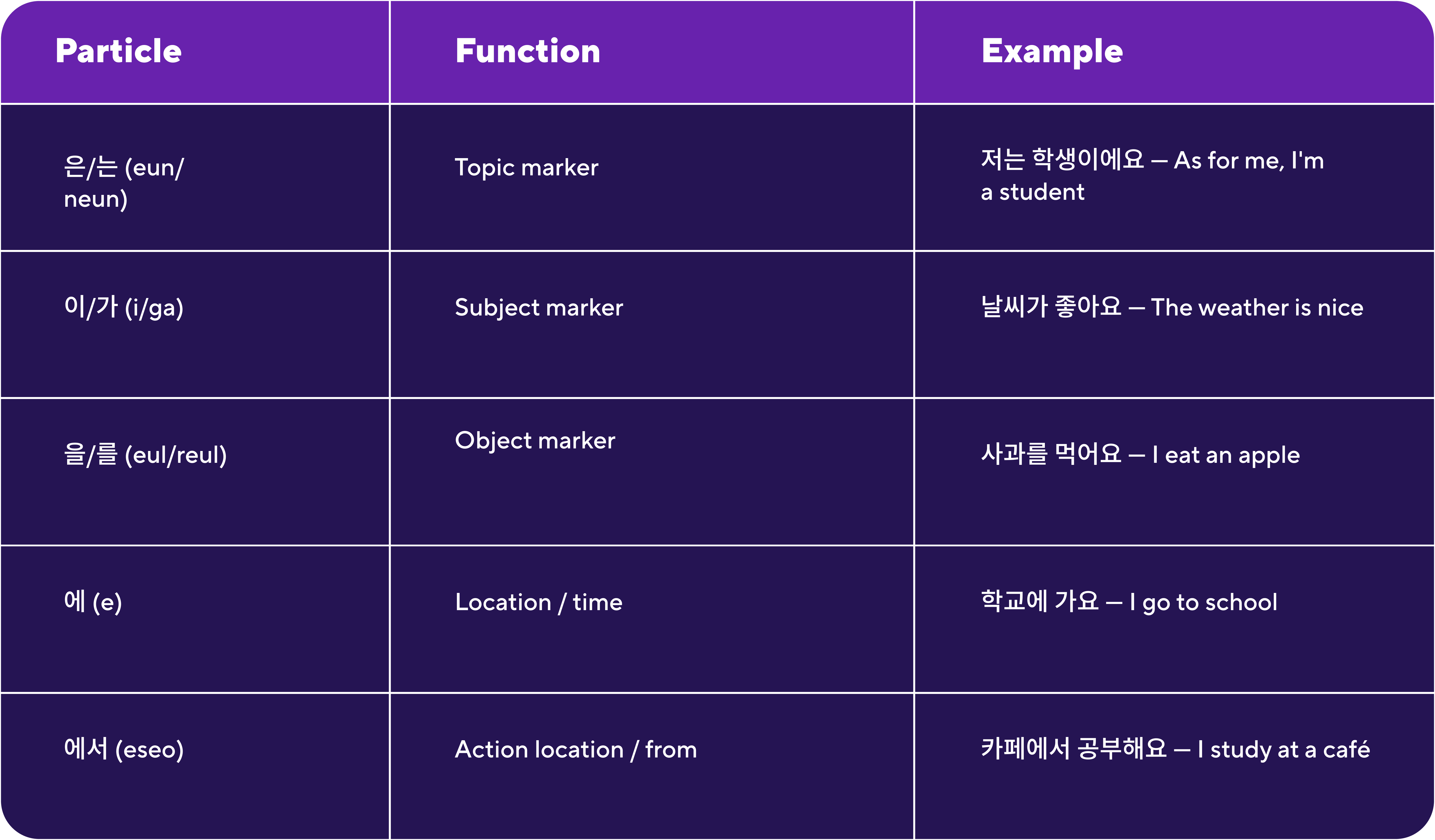
Think of Korean particles as name tags for nouns. They tell everyone at the sentence party who’s the topic, who’s the subject, and who’s getting the action. Here are the five you’ll use on day one:
🎯 Why it matters
The difference between 은/는 and 이/가 trips up every beginner. Quick rule of thumb: 은/는 sets the scene (“as for X…”), while 이/가 highlights new or important info (“X is the one that…”). You’ll develop a feel for it with practice — and the Drops grammar modules have dedicated drills for these rules.

Every Korean verb in the dictionary ends in 다 (da). That’s your starting point. To conjugate, you drop the 다, take what’s left (the verb stem), and add an ending based on tense, politeness, and mood. Let’s see this in action with one of the first verbs you’ll learn:
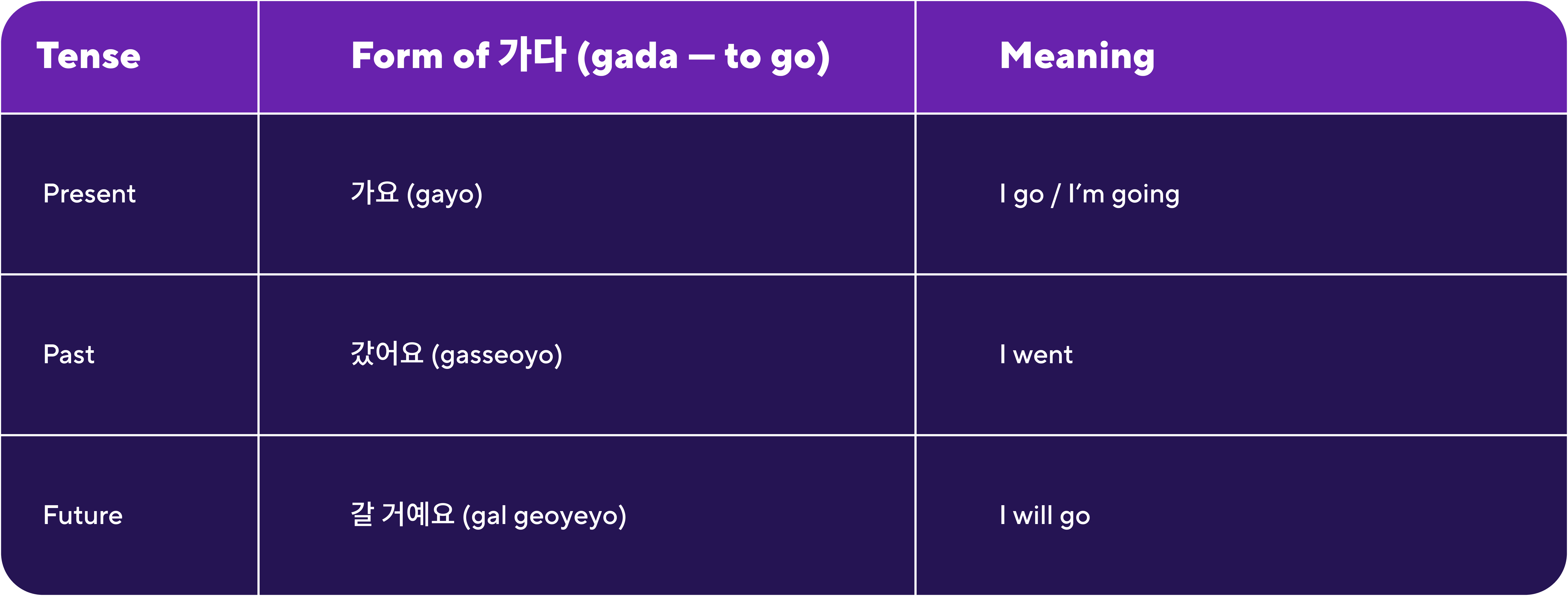
See the pattern? The stem 가 (ga) stays constant — only the ending changes. Once you learn these three endings, you can conjugate hundreds of verbs the exact same way. This consistency is what makes grammar in Korean surprisingly approachable once you get past the initial learning curve.
🤯 Mind-shift moment
In Korean, adjectives conjugate like verbs. The word for “to be pretty” is 예쁘다 (yeppeuda), and you conjugate it just like any verb: 예쁘요 (yeppeoyo — “it’s pretty”). No separate adjective rules to learn — it’s all one system.

This is the section that makes Korean culture fascinating — and occasionally nerve-wracking for beginners. Korean has multiple speech levels that change how you end every single sentence, depending on who you’re talking to. It’s not just about sounding polite; it’s about showing respect, building relationships, and fitting into social context.
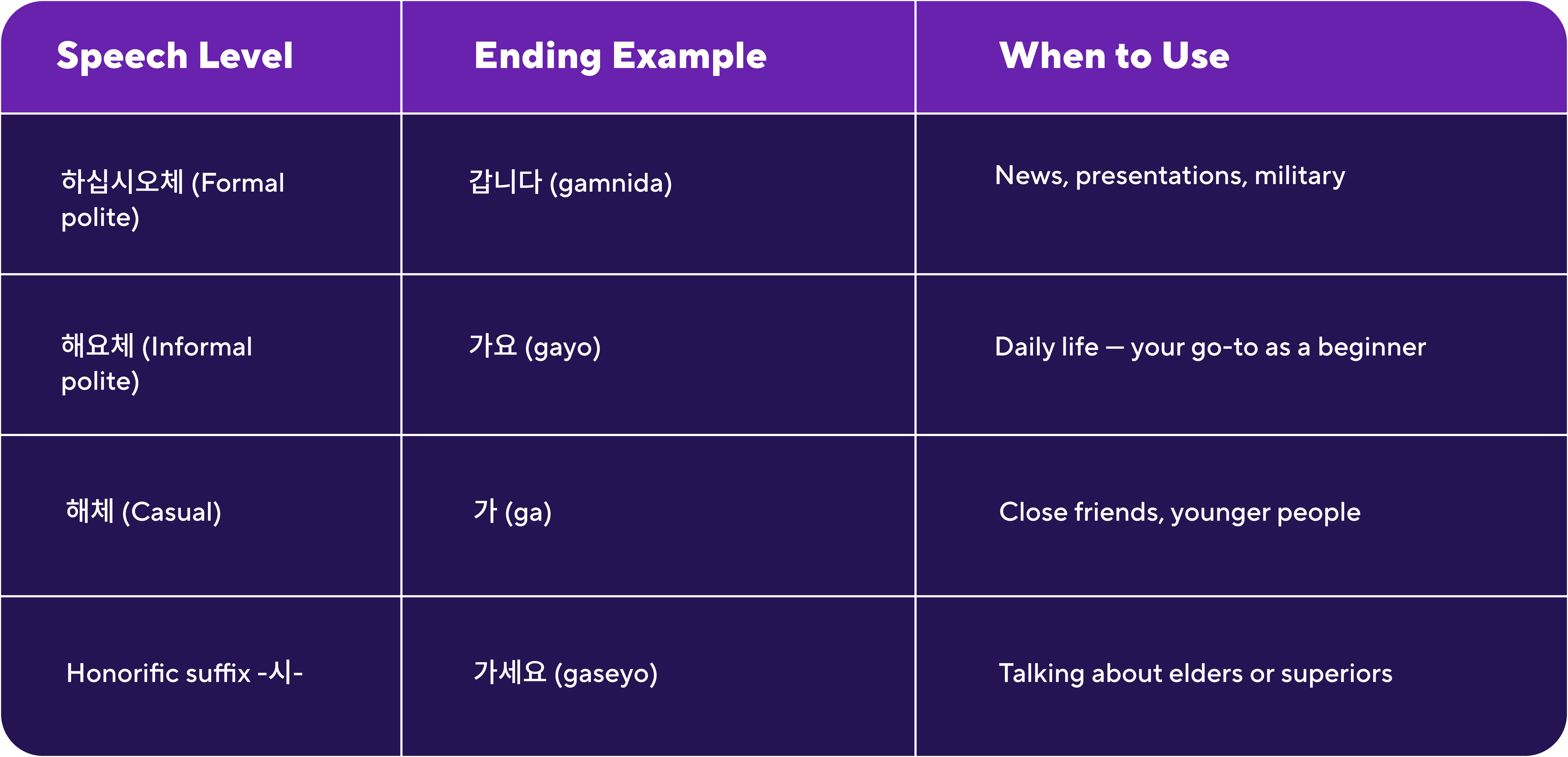
The good news? You really only need to worry about four levels as a learner:
🙋 Beginner advice
해요체 (informal polite) is your best friend. It’s appropriate for 90% of daily conversations — shops, restaurants, new acquaintances, coworkers. When in doubt, use 해요체. You’ll sound respectful without being stiff.
Getting Korean honorifics right matters socially. Using casual speech with someone older or in a higher position can come across as rude, even if your grammar is technically perfect. The Drops grammar modules are built around 해요체 (informal polite), ensuring you master the most practical speech level from the very first tap. Even everyday greetings change depending on context – see our guides on saying 'Hi’ in Korean and ‘Bye’ in Korean for a taste of how politeness shapes the simplest conversations.

After the complexity of speech levels, this section is a deep breath of fresh air. Korean nouns come with almost none of the baggage you’d find in European languages:
No masculine or feminine. A table is just a table — no memorizing whether it’s “he-table” or “she-table.”
No articles. No “the,” no “a,” no “an.” One fewer thing to overthink.
Plurals are optional. You can add the marker 들 (deul) to make something explicitly plural — 사람들 (saramdeul — “people”) — but in most cases, context does the work and you can skip it entirely.
One thing to know: Korean uses counters when counting specific things. Instead of saying “three cats,” you’d say “cat three-counter”: 고양이 세 마리 (goyangi se mari). Common counters include 개 (gae — general items), 명 (myeong — people), and 마리 (mari — animals). It takes a little getting used to, but there’s a satisfying logic to it. Start building your noun vocabulary with essential Korean words that you’ll use every day.
Want to say you don’t do something? Korean gives you two clean options:
Short negation
Just put 안 (an) before the verb. 안 먹어요 (an meogeoyo) = “I don’t eat.” Done.
Long negation
Add 지 않다 (ji anta) after the verb stem. 먹지 않아요 (meokji anayo) = same meaning, slightly more formal feel.
And questions? Even simpler. In spoken Korean, you often just raise your intonation at the end of a statement. 먹어요 (meogeoyo) with a flat tone = “I eat.” Same words with a rising tone = “Do you eat?” In writing, you add a question particle or simply a question mark. That’s it — no word-order gymnastics, no auxiliary verbs.
Quick win
You now know enough basic Korean grammar to build a simple self-introduction: 저는 [name]이에요. 한국어를 공부해요. (jeoneun [name]-ieyo. Hangugeoreul gongbuhaeyo. — I'm [name]. I study Korean.) That’s real communication, and you just learned the pieces to make it happen.
Korean grammar doesn’t have to be the intimidating monster it’s made out to be. The Korean grammar rules are consistent, the conjugation follows clear patterns, and once you get comfortable with particles and speech levels, you’ll find yourself reading signs, understanding song lyrics, and piecing together real conversations.
The key is practice — and not the “stare at a grammar table for 45 minutes” kind. If you’ve been wondering how to Learn Korean grammar without burning out, the answer is simple: see patterns, tap through examples, and build muscle memory one bite at a time.
That’s exactly what the new grammar modules in Drops are designed for. These bite-sized Korean grammar lessons take concepts like SOV word order, particle usage, and verb conjugation and turn them into short, visual, interactive sessions you can squeeze into a coffee break. If you’ve been meaning to Learn Korean but grammar was the thing holding you back, this is your on-ramp.
Download Drops and try the Korean grammar modules today. Your future self — the one confidently ordering in Korean at a Seoul restaurant — will thank you.

Start with SOV sentence structure, learn the basic particles (은/는, 을/를, 이/가), and practice conjugating a few common verbs in present tense. An app like Drops breaks these into manageable, visual lessons so you can build habits without overwhelm. Check out more Korean language resources to plan your study path.
Korean has two number systems. In the native Korean system: 하나 (hana), 둘 (dul), 셋 (set), 넷 (net), 다섯 (daseot), 여섯 (yeoseot), 일곱 (ilgop), 여덟 (yeodeol), 아홉 (ahop), 열 (yeol). In the Sino-Korean system: 일 (il), 이 (i), 삼 (sam), 사 (sa), 오 (o), 육 (yuk), 칠 (chil), 팔 (pal), 구 (gu), 십 (sip). Native Korean numbers are used for counting things and ages, while Sino-Korean numbers are used for dates, phone numbers, and money. You can practise these and more essential Korean words on the Drops blog.
The most common greeting is 안녕하세요 (annyeonghaseyo), which works in almost any situation. Among close friends you can shorten it to 안녕 (annyeong). For a deeper look at greetings and when to use each one, check out our guide on saying 'Hi’ in Korean.And while you’re at it, learn how to say ‘Bye’ in Korean too.
Korean grammar is different from English, but “different” doesn’t mean “hard.” The sentence structure (SOV) takes some getting used to, and particles are a new concept for most English speakers. But the system is remarkably consistent — very few irregular verbs, no gendered nouns, no articles. Most learners find the first few weeks challenging, then things start clicking fast once the core patterns become familiar.
Both languages share an SOV word order and use particles, so the grammar systems feel quite similar structurally. Japanese has the added complexity of three writing systems (hiragana, katakana, kanji), while Korean uses a single, highly logical alphabet (Hangul). On the grammar side, Korean’s speech levels can be tricky, but Japanese has its own honorific layers too. Overall, neither is objectively “harder” — it depends on your background and which patterns click for you.
Drops is a great starting point for Korean learners. It combines vocabulary building with new grammar modules that cover sentence structure, particles, conjugation, and honorifics in short, visual sessions. It’s designed for beginners who want to build real skills in just a few minutes a day. Explore more ways to learn Korean on the Drops blog.
For most people, yes. Apps break grammar into small, repeatable chunks instead of throwing everything at you in a single textbook chapter. Drops, for example, uses visual cues and spaced repetition to help patterns stick. The convenience factor matters too — five minutes on your commute adds up faster than a weekly class you keep postponing. Pair app practice with real-world exposure (K-dramas, music, conversations) and you’ve got a solid learning loop.
The biggest adjustment is word order — English puts the verb in the middle, Korean puts it at the end. Particles are also a new concept, since English relies on word order instead. But the trade-offs are generous: no gendered nouns, no articles, optional plurals, and verb conjugation that follows very predictable rules. Once you internalise the basics, Korean grammar actually feels cleaner than English in many ways. Browse common Korean phrases and words to see how these work in action.
Korean uses Subject–Object–Verb (SOV) order. The verb always goes at the end of the sentence. For example, “I drink water” becomes 저는 물을 마셔요 (jeoneun muleul masyeoyo — literally “I water drink”).
은/는 is the topic marker — it sets the scene or introduces known information (“As for me…”). 이/가 is the subject marker — it highlights new or important information (“This is the one that…”). Both can mark the subject, but the nuance changes what you’re emphasizing.
Korean has seven traditional speech levels, but modern daily life uses about four. Beginners should focus on 해요체 (informal polite) — it’s appropriate for the vast majority of everyday conversations and strikes the right balance between respectful and natural.
No grammatical gender at all — a table is just a table, no masculine or feminine forms to memorise. Plurals are technically optional: you can add 들 (deul) to make something explicitly plural (사람들, saramdeul — “people”), but in most contexts Korean speakers skip it and let context do the work. This is one of the genuinely easy parts of Korean grammar.


"Love my fun language learning and practice with daily Drops sessions, and monthly Challenges to participate in, and quiz mode to test contextual learning - brilliant! So much thought, consideration and inclusivity has gone into the design and function of this app, I can't praise it highly enough."
"Great little learning app! I've learned at least 5-10 new words in Spanish in my first 5 minutes. Easy to pick up and thorough."
"Great language learning app! It helps you get daily words done in a short amount of time. I would highly recommend using drops to learn whatever language you want to learn."
"What an amazing app! I’ve tried several apps for language learning and I cannot recommend Drops enough. I don’t know how a short Drops session can teach me as much as 1 hour+ of focused use of other apps, it’s like magic."
"Amazing language learning tool. Excellent app for increasing vocabulary in your foreign language of choice. Useful for beginner, intermediate, and advanced learners. The repetition of the words makes them much easier to remember, and without the hassle of making your own flash cards. I have used Drops for two years now and have seen great results."
"Very engaging way of learning Yoruba in a stimulating way. Will be using to learn myself and to teach my child!"
"Less than a week in but using this alone with the popular one babbel working on German. When using just one app I got bored, babbel is not as fun. So using both at once actually let's my adhd do its thing but I still focused since I can switch easily between both apps and work in different areas. Also I like the quick little sessions makes me feel like I actually did something."
"So engaging. I speak Spanish well, but often forget words in conversation that I know I should know. This game is fun and quickly brings back vocabulary I may have put in the back of my brain after not using it for awhile. Case in point: I spent 11 years in construction, then went back to teaching in English and/or Spanish depending on the teacher/student"
"Amazing app"
"I have been desperate to find an app that really helps me learn Japanese and this is the best by far"
"I like that you can switch between different subjects and topics constantly and it’s really easy to learn a lot of vocabulary very quickly! This works perfect for me because I can learn a lot of words but then practice sentence structure with my grandmother whose from Croatia"
"Fantastic app great opportunity to learn languages on your spare time. Drops makes it easy to learn and retain words to formulate sentences."
"Best of the best. Awesome app in every sense"
"This app us the best and how I am doing Learning Ukraine is Helping me alot tnx"
"Definitely recommend! I'm using this to learn mandarin 10/10"
"Fun and interactive. Great for repetition!"
"Very engaging way of learning Yoruba in a stimulating way. Will be using to learn myself and to teach my child!"
"Great little learning app! I've learned at least 5-10 new words in Spanish in my first 5 minutes. Easy to pick up and thorough."
"I have been desperate to find an app that really helps me learn Japanese and this is the best by far"
"I like that you can switch between different subjects and topics constantly and it’s really easy to learn a lot of vocabulary very quickly! This works perfect for me because I can learn a lot of words but then practice sentence structure with my grandmother whose from Croatia"
"Fantastic app great opportunity to learn languages on your spare time. Drops makes it easy to learn and retain words to formulate sentences."
"What an amazing app! I’ve tried several apps for language learning and I cannot recommend Drops enough. I don’t know how a short Drops session can teach me as much as 1 hour+ of focused use of other apps, it’s like magic."
"Love my fun language learning and practice with daily Drops sessions, and monthly Challenges to participate in, and quiz mode to test contextual learning - brilliant! So much thought, consideration and inclusivity has gone into the design and function of this app, I can't praise it highly enough."
"Definitely recommend! I'm using this to learn mandarin 10/10"
"This app us the best and how I am doing Learning Ukraine is Helping me alot tnx"
"Less than a week in but using this alone with the popular one babbel working on German. When using just one app I got bored, babbel is not as fun. So using both at once actually let's my adhd do its thing but I still focused since I can switch easily between both apps and work in different areas. Also I like the quick little sessions makes me feel like I actually did something."


